
Rovo Redefined
How I led the transformation of Atlassian’s Rovo from a basic chat feature into a central, workflow-embedded AI platform—driving a new design system, multi-team innovation, and a company-wide AI evolution.
Project Context
Context
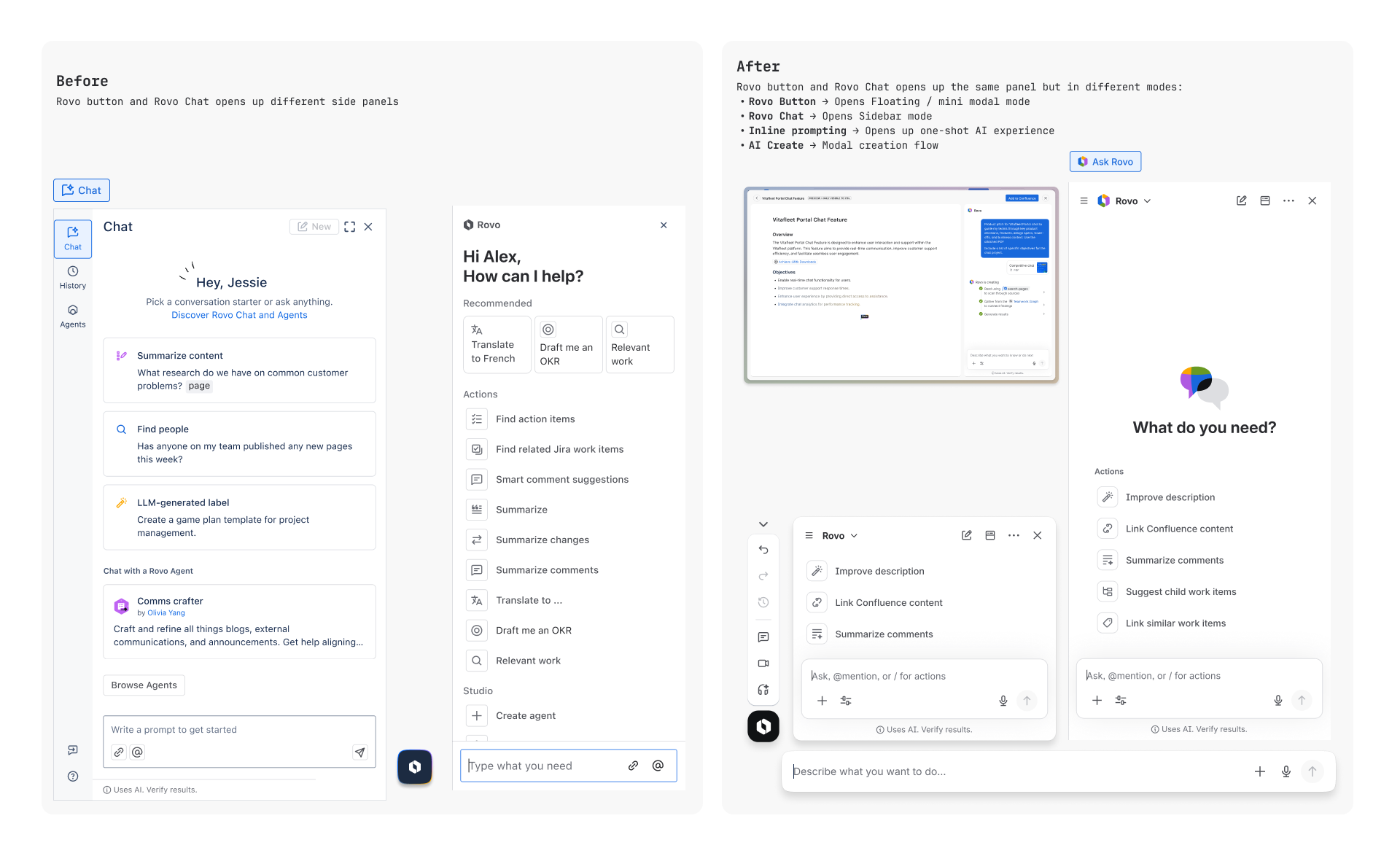
When I joined Atlassian, Rovo—the company’s flagship AI product—was a constrained sidebar chat with an outdated visual language and a confusing system of hundreds of specialized agents. It wasn’t modern, it wasn’t competitive, and most importantly, it wasn’t deeply embedded into the user’s workflow.
Challenges
Outdated design system (ADS) that limited visual expression and interaction patterns
Fragmented agent model that forced users to know which agent did what
Chat restricted to a static sidebar with no inline or embedded intelligence
No cohesive AI vision across the Atlassian suite
My Role
I owned the product and design vision for Rovo Chat and the future of Atlassian’s AI experience. I:
Identified critical usability, design, and competitive gaps
Built the case for a new AI design system and a complete product strategy overhaul
Championed a company-wide realignment around AI
Ran a tiger team of Principal design leads from across the company to reimagine the end-to-end North Star Experience
Ran several tiger team workshops and strategic leadership reviews
Drove execution across 32+ teams to transform Rovo into a platform experience
Project Kickoff
Identifying the Problem
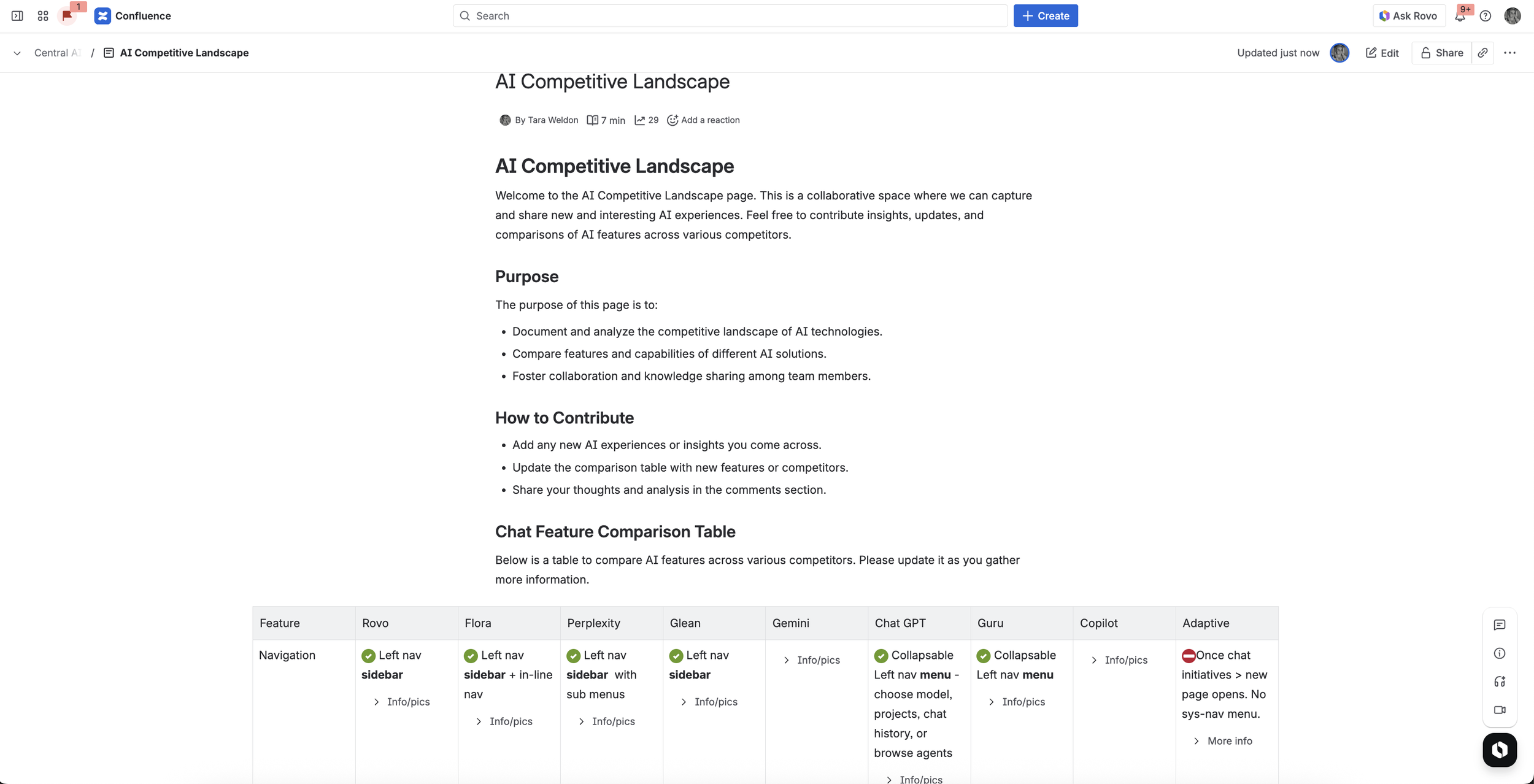
My first step was to run a deep competitive analysis of ChatGPT, Gemini, Anthropic, Replit, Cursor, Protopie, Vercel, and other emerging AI tools. I mapped:\
Interaction patterns
Chat modalities
Workflow integration strategies
Design system capabilities
Multimodal features
The gaps were clear—and severe. Rovo was falling behind.
Making the Case to Leadership
I synthesized findings into a strategic brief and presented it to our VP, highlighting:
The limitations of ADS
The fragmentation of our agent model
The missing cross-suite AI workflows
The risk of shipping a dated experience for GA
I proposed:
A full visual + interaction redesign
A new AI-specific design system
A cross-company Design Leadership workshop to realign all product teams
Dedicated design + product + engineering resourcing (tiger team)
The Workshop
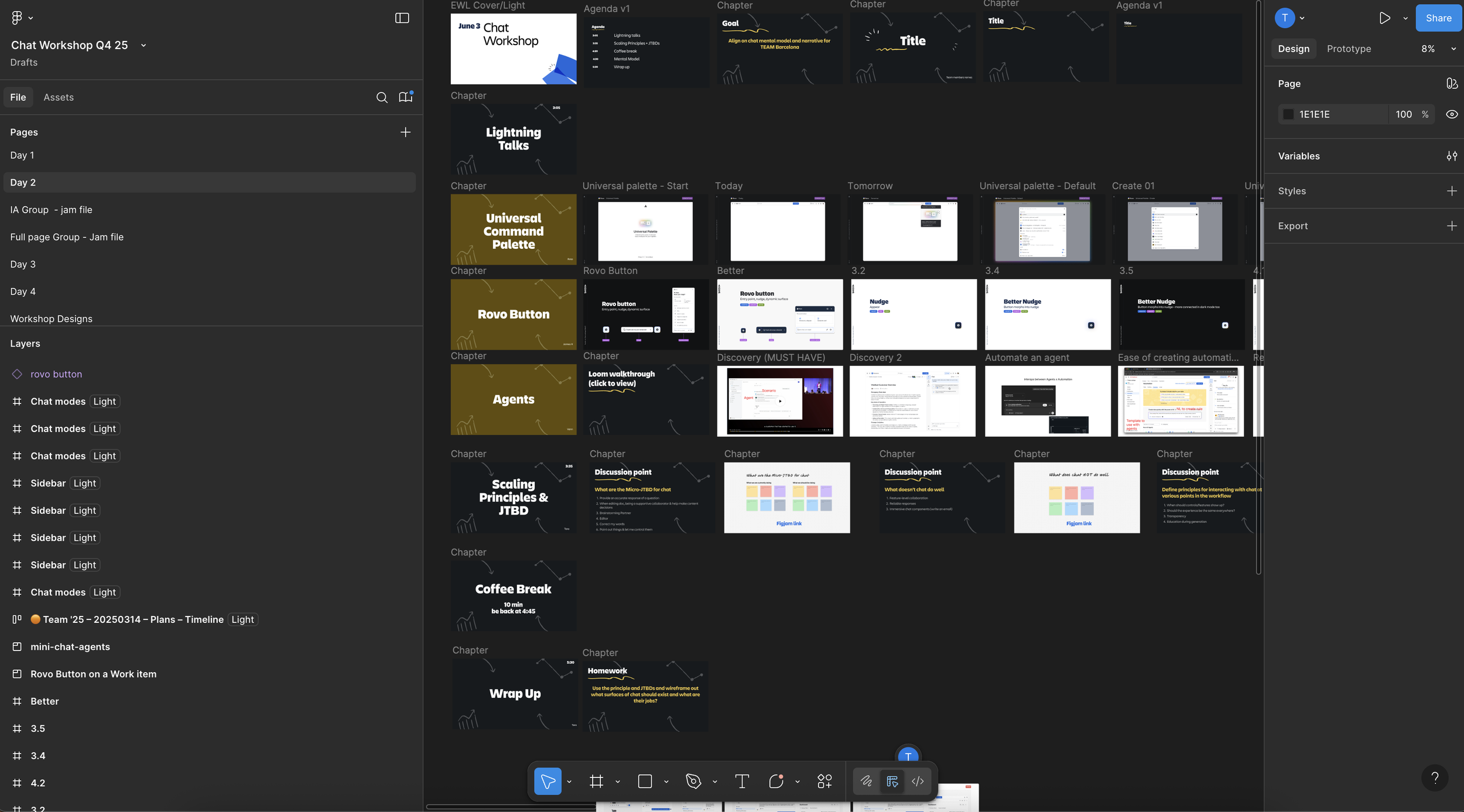
Unifying 32 Teams Around a New AI Vision. To break the siloed and fragmented approach to AI at Atlassian, I planned, facilitated, and led a cross-company workshop with 32 teams across Jira, Confluence, Atlas, Compass, Ecosystem, and Platform.
Workshop Goals
-
1
Define a unified vision for Rovo
-
2
Redesign the entire chat experience
-
3
Create principles for the AI interactions across products
-
4
Decide where AI should live in user workflows
-
5
Validate the need for a new AI design system
The workshop
What I Delivered
Full workshop agenda & exercises
Vision-setting exercises
Co-creation sketches of new chat experiences
Workflow mapping for “Create with Rovo”
Alignment with design, engineering, product, and leadership
Workshop Outcome
The workshop produced:
A brand-new chat architecture
Agreement on three core chat modalities (inline, floating, full-page)
Concept for Create with Rovo
Foundational patterns for the Rovo Design System
A multi-quarter roadmap embraced across all teams
Launching the Product Work-streams
Based on the workshop outcomes, I kicked off and drove multiple major workstreams:
New chat modalities
A single sidebar chat was no longer enough.
I designed and led the definition of:
Inline Chat → AI appears where you work (in Jira tickets, Confluence pages)
Floating Chat → always-available, lightweight interaction
Full-Page Chat → deep work, research, drafting, exploration
Each modality had unique UX, component needs, and interaction patterns—which informed the new design system.
Create with Rovo Flow
The biggest leap forward: turning AI from chatting into creating.
This became:
A multimodal AI-driven drafting experience
A structured workflow for content generation
A cross-product creation flow for Jira, Confluence, and beyond
I defined:
Entry points across workflows
Drafting + iteration patterns
Content validation steps
Multi-agent orchestration
The publishing model
This work became the foundation of Atlassian’s new AI-powered workflow model.
AI Design Kit
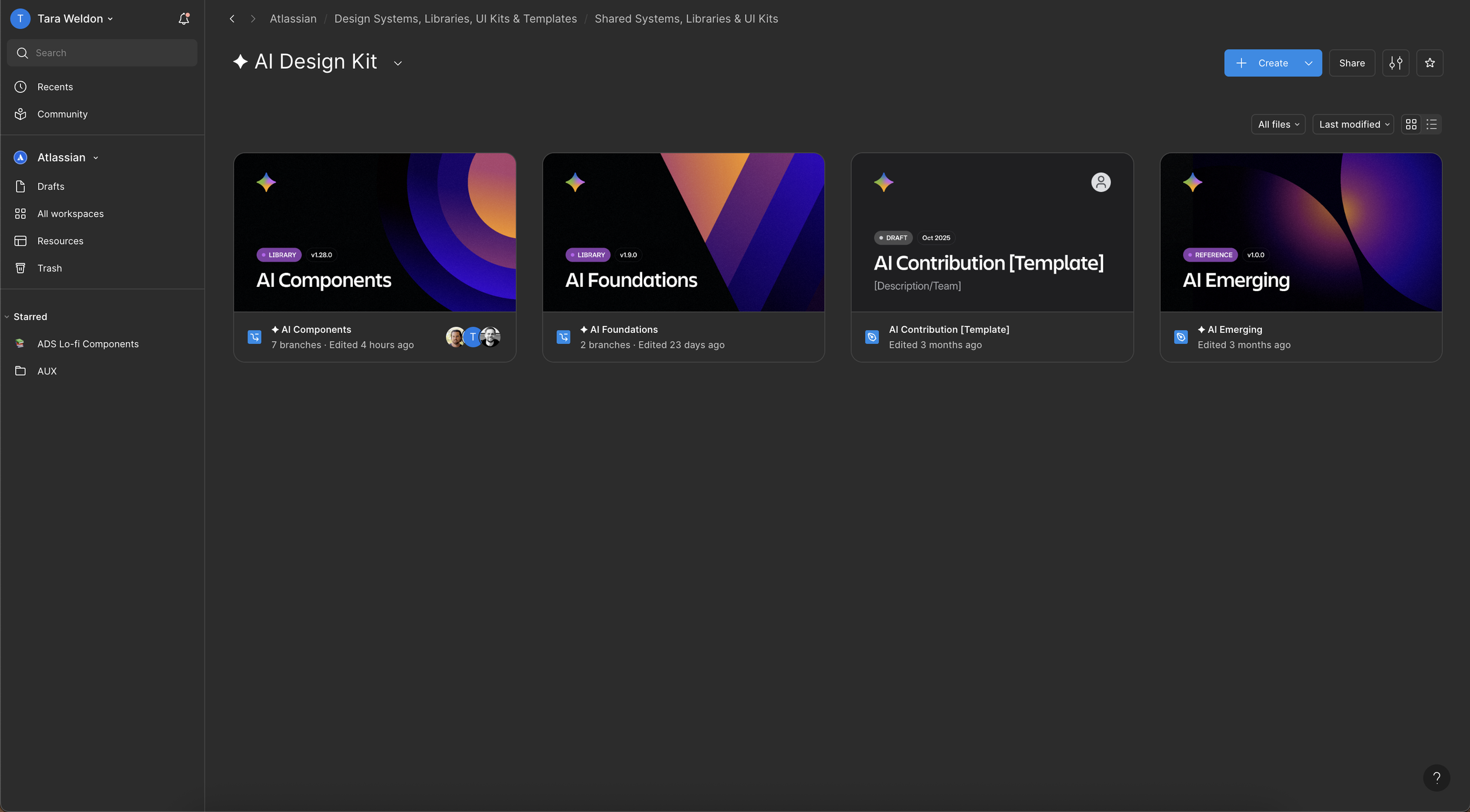
I advocated for—and drove the formation of—the team that now owns Atlassian’s dedicated AI design system.
AI Design Kit now includes:
AI-specific UI components
Chat orchestration architecture
Prompt UX patterns
Inline intelligence patterns
Evaluation + feedback patterns
Multimodal patterns for image, tables, code
This became a new design organization within Atlassian Central AI Rovo.
Final Result
Rovo transformed into a unified AI platform
Modern, sleek, and competitive visual design
Chat embedded across multiple surfaces
Workflow-powered creation tools
Cohesive AI behavior and interaction patterns
A scalable design system for all future AI features
Rovo now feels:
Integrated
Intelligent
Elevated
Future-proof
And genuinely useful
Outcome & Impact
Company-Wide Impact
Rovo’s new experience became the centerpiece of the founders’ keynote at Team ’25 and Team ’25 EU
35+ teams showcased demos built on the patterns I created
Sparked new hiring, new AI teams, and new design system org
Rovo became Atlassian’s flagship strategic priority
Business Impact
Significant revenue growth tied to AI add-ons
Investor excitement and shareholder momentum
Surge in customer engagement and product usage
Strong validation from analysts and the developer community
Organizational Impact
Shifted Atlassian from “AI as a feature” → AI as the product
Unified design + product around a cohesive AI vision
Established scalable infrastructure for all future AI tools